

Reference
Muhurat Trading: what it is, 2026 timings, and how the Nifty has moved every year since 2016
The one-hour Diwali session explained, with the Nifty 50's result in every muhurat session from 2016 to 2026. Updated each Diwali.
Edited by Kushal Pugalia
Published
The short answer
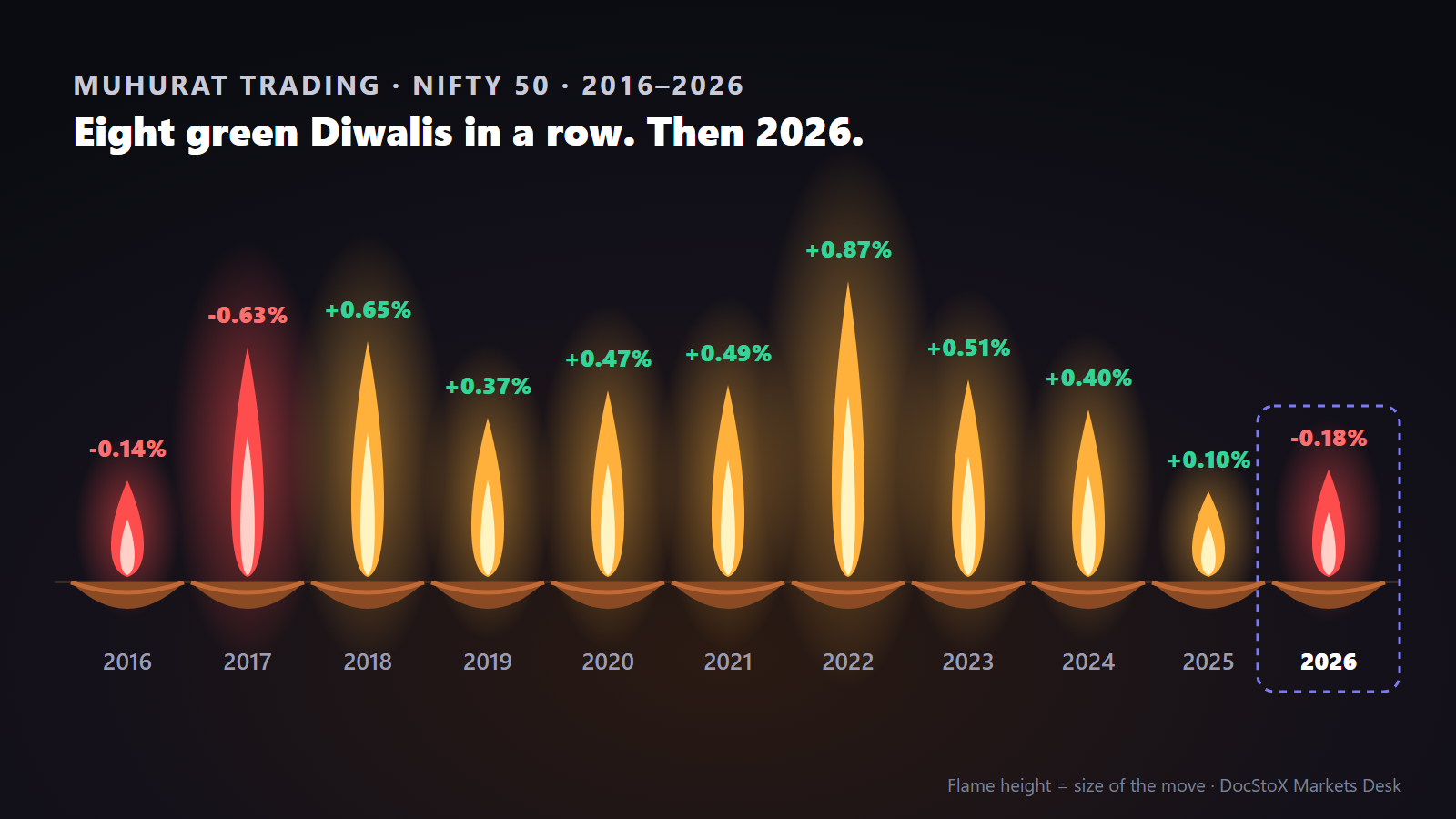
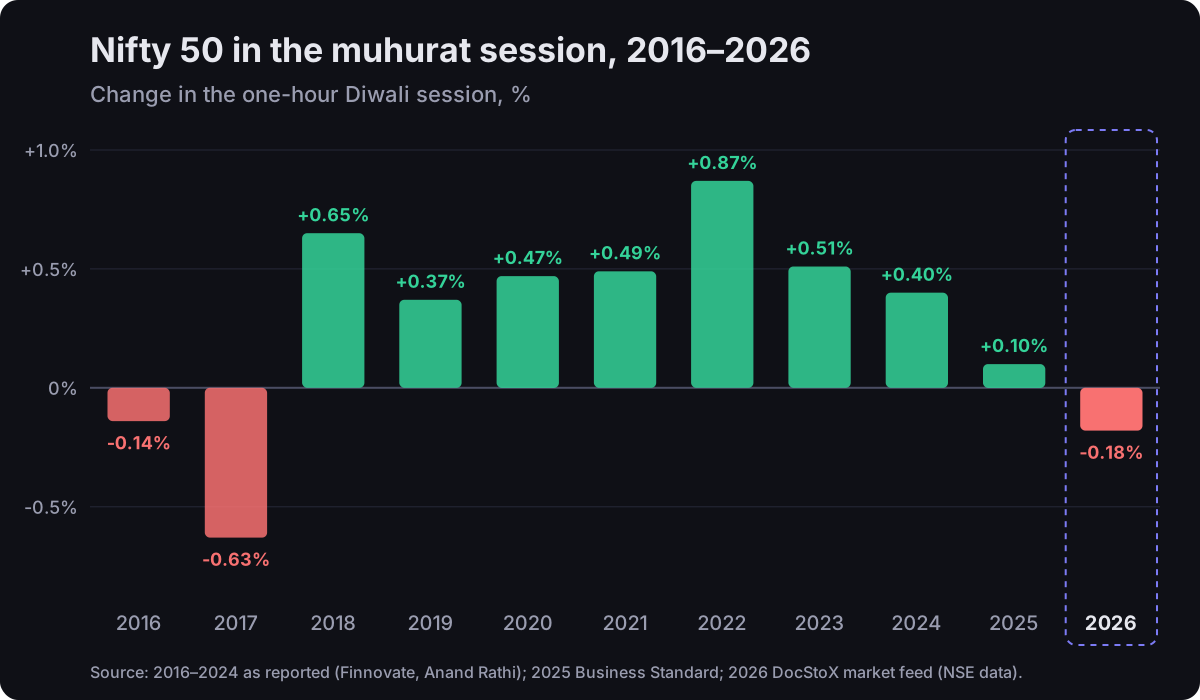
Muhurat trading is a one-hour trading session that NSE and BSE hold on Diwali to mark the start of the new Hindu accounting year, Samvat. In 2026 it ran on Sunday, 8 November, from 2:20 pm to 3:30 pm IST. Across the eleven sessions from 2016 to 2026, the Nifty 50 rose in eight and fell in three, and never moved more than 1% either way.
Key numbers
Data as of Muhurat session of 8 Nov 2026
Muhurat 2026 (Samvat 2083)
Nifty −0.18%
Closed at 24,986.40 on 8 Nov 2026
Source: DocStoX market feed (NSE)
Green sessions, 2016–2026
8 of 11
Eight in a row from 2018 to 2025
Source: DocStoX Markets Desk, from the table below
Biggest move
+0.87%
2022. The biggest fall was −0.63% in 2017
Source: Published muhurat tables (Finnovate, Anand Rathi)
Average move, 2016–2026
+0.26%
Simple average of the eleven sessions
Source: DocStoX Markets Desk calculation
What is muhurat trading?
"Muhurat" means an auspicious time. On Diwali, many Indian traders and business families start their new account books, and the stock exchanges hold a short special session so investors can make a token trade at the start of the new Samvat year.
The session is short and usually quiet. Trading volumes are low, and most participants buy small quantities as a ritual rather than to trade.
When was muhurat trading in 2026?
| 2026 | |
|---|---|
| Date | Sunday, 8 November 2026 (Diwali, Lakshmi Puja) |
| Session | 2:20 pm to 3:30 pm IST |
| New year | Samvat 2083 |
| Settlement | Monday, 9 November (T+1) |
Trades made in the session are normal trades: they settle like any other day's trades and carry the usual charges.
How the Nifty 50 moved in every muhurat session since 2016
| Year | Samvat | Nifty 50 in the session | Report |
|---|---|---|---|
| 2016 | 2073 | −0.14% | |
| 2017 | 2074 | −0.63% | |
| 2018 | 2075 | +0.65% | |
| 2019 | 2076 | +0.37% | |
| 2020 | 2077 | +0.47% | |
| 2021 | 2078 | +0.49% | |
| 2022 | 2079 | +0.87% | |
| 2023 | 2080 | +0.51% | |
| 2024 | 2081 | +0.40% | |
| 2025 | 2082 | +0.10% | |
| 2026 | 2083 | −0.18% | Full report |
What the history shows, and what it does not
- The moves are small. In eleven years the Nifty never moved more than 1% in the session. The average was +0.26%.
- Green is common, not guaranteed. Eight of eleven sessions closed higher, including eight in a row from 2018 to 2025. 2026 broke that run.
- It does not predict the year. Samvat 2082 opened with a +0.10% muhurat and became the weakest Samvat for the benchmarks in 15 years, with the Nifty down 3.4% from Diwali to Diwali.
A one-hour session with thin volumes is a tradition and a talking point. It is not a forecast.
Latest muhurat report
Muhurat Trading 2026: Sensex, Nifty end lower for the first time since 2017: the session in detail, why most stocks rose while the index fell, and Samvat 2082 in numbers.
Sources and methodology
- DocStoX market feed: 2026 muhurat-session close
- Business Standard: 2025 muhurat-session close
- Finnovate, 20 years of muhurat trading: Nifty 50 muhurat-session changes before 2025, as reported
- Anand Rathi, muhurat trading 10-year data: Cross-check of the pre-2025 figures
- NSE circular on the 2026 muhurat session: Circular NSE/CMTR/76941: session date and timings for 8 Nov 2026
Each figure is the Nifty 50's percentage change from the previous trading day's close to the muhurat-session close. Published tables differ by a few hundredths of a point in some years (2017, 2018, 2022, 2023); we use the value most sources agree on. The average is a simple mean of the eleven sessions and is not an estimate of any future session.
This story reports market data and public information. It is not investment advice or a recommendation to buy, sell or hold any security. Past performance does not indicate future returns. How we report: editorial policy, methodology, corrections. DocStoX uses software to gather data and draft text; a named editor reviews every story before it is published.
DocStoX Markets Desk
Data and research desk
The DocStoX Markets Desk turns exchange data, company filings and DocStoX's own market datasets into plain-language reporting. Every story is built from a source pack of verified figures and reviewed by a named editor before it is published.
Kushal Pugalia
Founder & Editor, DocStoX Markets Desk
Kushal built DocStoX because Indian market news told him what happened but rarely showed the numbers behind it. He edits the Markets Desk on one rule: no number goes out until it can be traced back to the exchange, the filing or the data it came from.
Every report
Get the next Markets Desk story
The DocStoX Dispatch brings the day's most useful market finding to your inbox. Subscribe to Dispatch · All Markets Desk stories