

Muhurat Trading 2026
Muhurat Trading 2026: Sensex, Nifty end lower for the first time since 2017
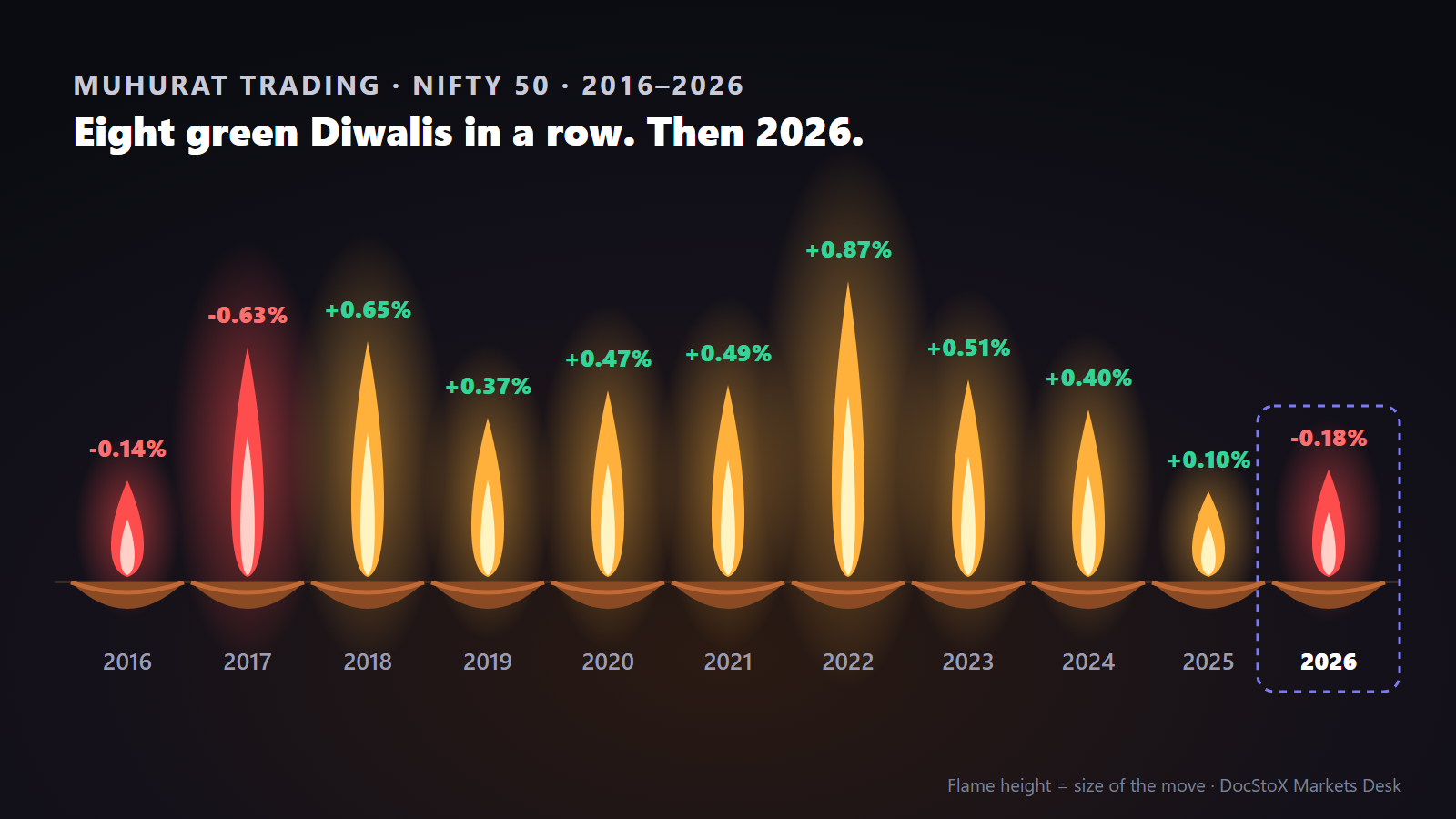
The index slipped 0.18% in the Samvat 2083 session, ending eight straight green Diwalis. But of the stocks that moved, nearly four in five rose. Here is what the data shows, and what the year before it looked like.
Edited by Kushal Pugalia
Published
The short answer
In the one-hour Samvat 2083 muhurat session on Sunday, 8 November 2026, the Nifty 50 closed 43.95 points lower (−0.18%) at 24,986.40 and the Sensex closed 28.62 points lower (−0.04%) at 80,999.40. That ends a run of eight green muhurat closes from 2018 to 2025. The fall was narrow: banks and financial stocks pulled the indices down, while 2,417 stocks rose and only 680 fell.
Key numbers
Data as of 8 Nov 2026, 15:30 IST (index closes, DocStoX market feed)
Nifty 50 close
24,986.40
−43.95 pts (−0.18%) vs 25,030.35 on 6 Nov
Source: DocStoX market feed (NSE)
Sensex close
80,999.40
−28.62 pts (−0.04%) vs 81,028.02 on 6 Nov
Source: DocStoX market feed (BSE)
Stocks that rose vs fell
2,417 vs 680
Active NSE stocks in DocStoX's live feed; 3.55 risers for every faller
Source: DocStoX market breadth
Inside the Nifty 50
17 up, 32 down
One unchanged. Banks and financials led the decline
Source: DocStoX market breadth
Nifty Bank
−0.40%
Closed at 58,850.65
Source: DocStoX market feed (NSE)
India VIX
18.49
+5.84%. The market's expected-volatility gauge rose
Source: DocStoX market feed (NSE)
What happened in the session
The muhurat session ran from 2:20 pm to 3:30 pm IST and opened Samvat 2083, the new Hindu calendar year that Indian traders mark with a token "auspicious" trade on Diwali.
The Nifty opened higher at 25,070.45 and climbed to 25,131.85, about 0.4% above Friday's close. It then drifted lower for most of the hour and closed at 24,986.40, almost exactly at its low for the session (24,985.30). The Sensex traded between 80,932.42 and 81,442.11 before closing at 80,999.40.
Trades from the session settle on Monday, 9 November.
The index fell. Most of the market did not.
This is the part a red headline hides. The two benchmark indices fell, but the broader market rose:
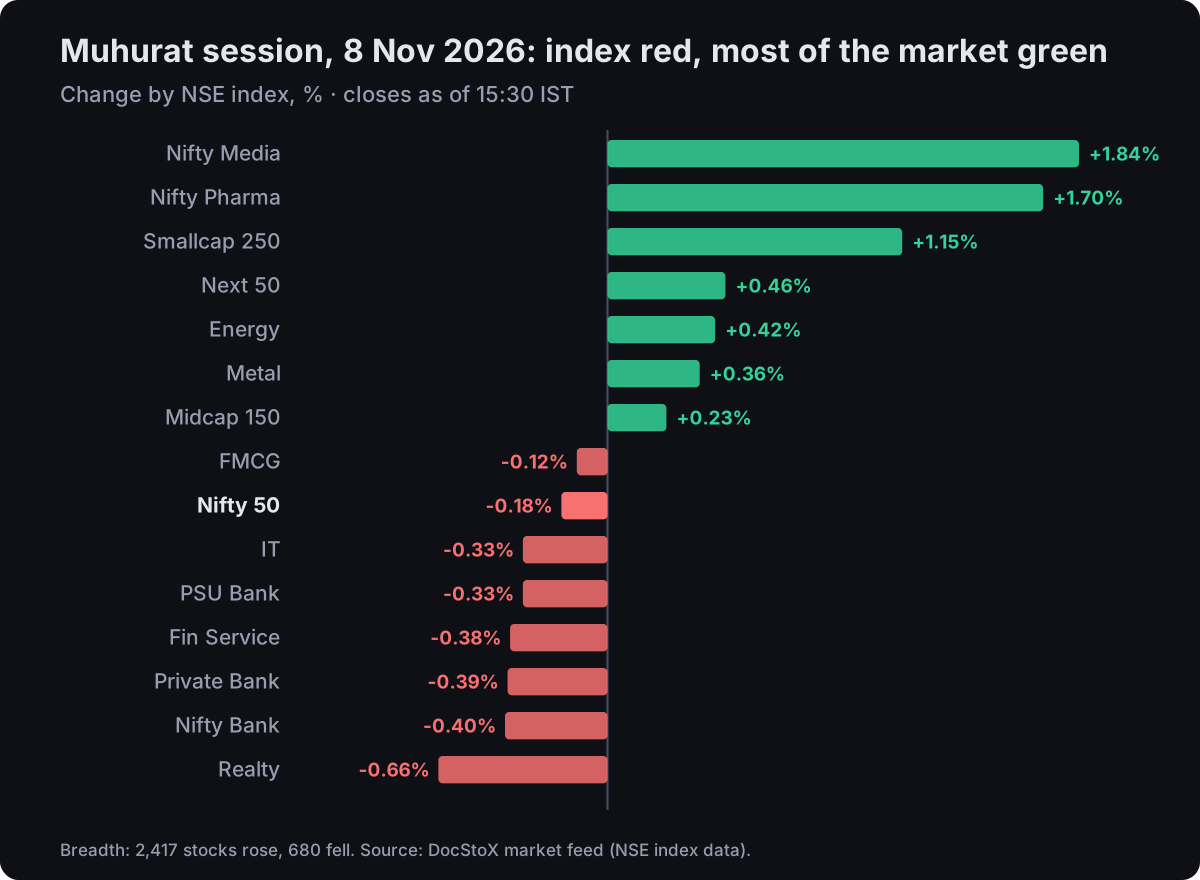
| Index | Change in the session |
|---|---|
| Nifty Media | +1.84% |
| Nifty Pharma | +1.70% |
| Nifty Smallcap 250 | +1.15% |
| Nifty Next 50 | +0.46% |
| Nifty Midcap 150 | +0.23% |
| Nifty 50 | −0.18% |
| Nifty Fin Service | −0.38% |
| Nifty Bank | −0.40% |
| Nifty Realty | −0.66% |
Why the gap? Banks and financial companies carry the largest weight in the Nifty 50, so a small fall in them outweighs bigger gains in smaller sectors. Inside the Nifty 50, 32 stocks fell and 17 rose. Across all active NSE stocks in our feed, 2,417 rose and 680 fell.
What this means for an investor: a red Nifty close told you very little about how most portfolios did on Sunday. If you held small or mid-sized companies, or pharma stocks, your holdings were more likely to be up than down.
The stocks that moved
| Stock | Muhurat close | Change vs 6 Nov | What we know |
|---|---|---|---|
| Finolex Cables | ₹1,309.20 | +20.0% | Hit the 20% upper limit. No company announcement found to explain it |
| Aster DM Healthcare | ₹747.00 | +4.7% | No single company-specific trigger found |
| Sun Pharma | ₹1,922.10 | +3.3% | Moved with the pharma index (+1.7%) |
| Tata Steel | ₹190.30 | +2.1% | First session after it reported higher September-quarter profit on 7 Nov |
| Trent | ₹3,050.00 | −0.9% | Moved with the market; no company news |
| Bharti Airtel | ₹2,090.50 | −0.8% | Moved with the market; no company news |
| SBI Life | ₹1,769.90 | −0.8% | Financial stocks were weak |
| IndiGo | ₹5,439.00 | −0.7% | Moved with the market; no company news |
| Mahindra & Mahindra | ₹3,267.80 | −0.6% | Had risen 6.15% on 6 Nov after its results |
| Infosys | ₹1,175.00 | −0.5% | IT index fell 0.33% |
| HDFC Bank | ₹784.45 | −0.5% | Bank index fell 0.40% |
Session closes from Tapetide's NSE live feed; previous closes from NSE end-of-day data. These are provisional until NSE publishes its official closing file for 8 November, and we will update this table then. A move "with the market" means we found no company-specific news, so the cause is not established.
Muhurat trading since 2016
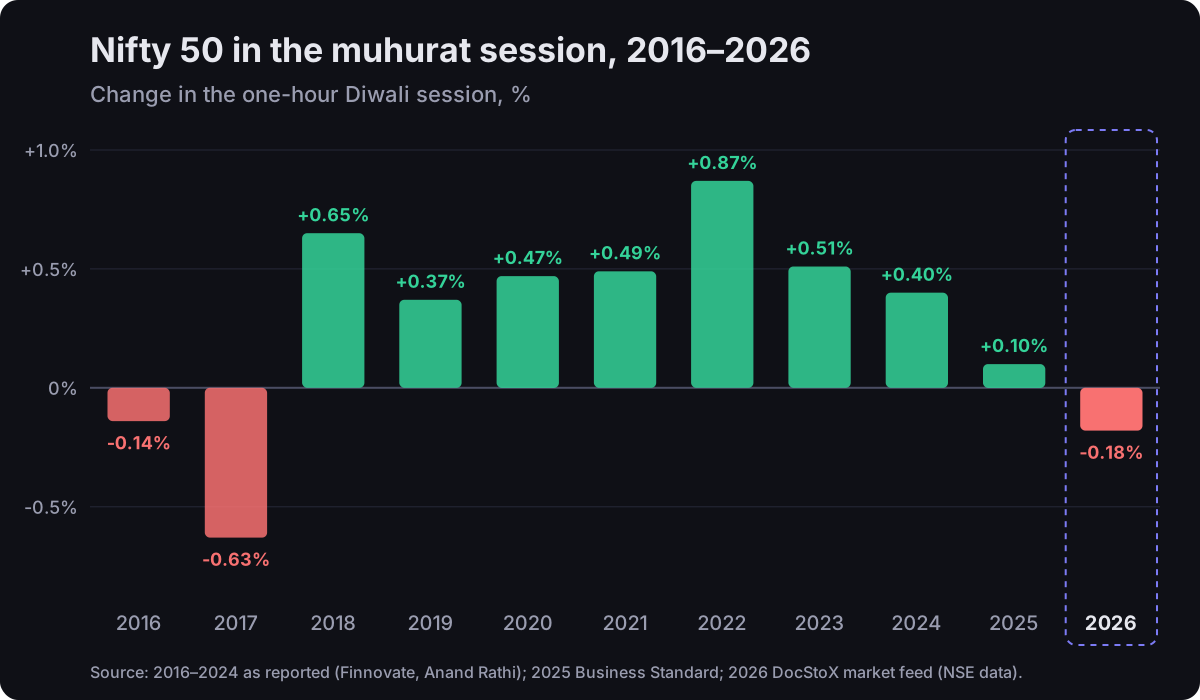
| Year | Nifty 50 in the session |
|---|---|
| 2016 | −0.14% |
| 2017 | −0.63% |
| 2018 | +0.65% |
| 2019 | +0.37% |
| 2020 | +0.47% |
| 2021 | +0.49% |
| 2022 | +0.87% |
| 2023 | +0.51% |
| 2024 | +0.40% |
| 2025 | +0.10% |
| 2026 | −0.18% |
In eleven sessions, the Nifty never moved more than 1% either way. That is what you would expect from one hour of light, ceremonial trading. The session's direction also says little about the year ahead: Samvat 2082 began with a +0.10% muhurat and went on to become the weakest Samvat for the benchmarks in 15 years.
For every year since 2016 in one place, see our muhurat trading history.
The week before Diwali: the biggest weekly gain since February 2021
The muhurat session came straight after an unusual run:
- In the week of 2 to 6 November, the Nifty rose 1,977 points (+8.57%) and the Sensex 6,568 points (+8.82%), their largest weekly gains since February 2021.
- Over the seven sessions to 6 November, the Nifty climbed from 22,698.85 to 25,030.35, a 10.27% gain.
- On 5 November the Nifty rose 2.40% on a day when the Nasdaq Composite fell about 5.5%, Korea's Kospi 6.02% and Japan's Nikkei 5.96%. US coverage tied the US fall to a sell-off in AI and chip stocks after the US midterm elections.
- Foreign institutional investors (FIIs) bought a net ₹14,975 crore of Indian shares on 5 November and ₹13,750 crore on 6 November, after selling for most of the year.
Reports at the time credited returning foreign money, easier crude oil prices, better-than-feared September-quarter results and a firmer rupee.
Samvat 2082 in numbers: Diwali 2025 to Diwali 2026
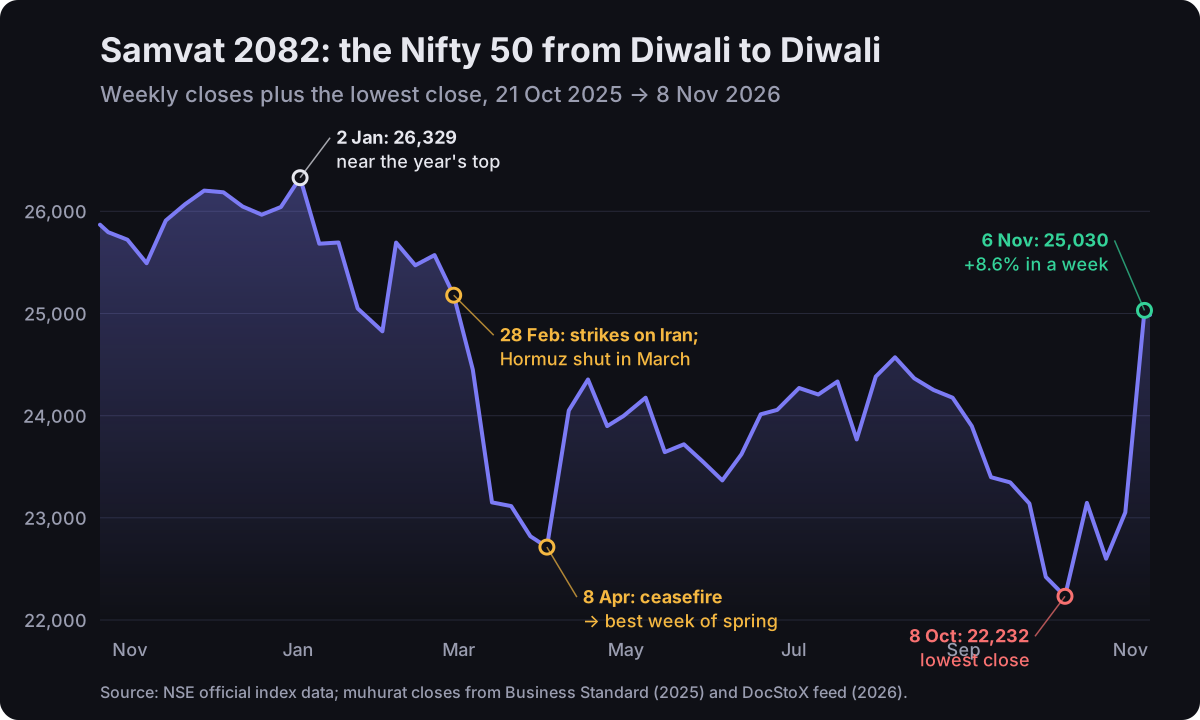
| Measure | Samvat 2082 |
|---|---|
| Nifty 50 | 25,869 → 24,986.40, −3.4% |
| Sensex | 84,426 → 80,999.40, −4.1% |
| Rank | Weakest Samvat for the benchmarks in 15 years; the last worse one was in 2011 (−17.4%) |
| Nifty, top to bottom | About 26,329 (2 Jan 2026) to 22,231.80 (8 Oct 2026), −15.6% |
| Gold in India | +10.8%, to about ₹1.41 lakh per 10 grams |
| Silver in India | +12.2% |
| Foreign investors | Record net selling of about ₹4.55 lakh crore |
| Nifty 50 price-to-earnings | 22.67 in the week before Diwali 2025 → 20.65 on 6 Nov 2026 |
What drove the year, as reported. US and Israeli strikes on Iran began on 28 February 2026, and shipping through the Strait of Hormuz was cut off in early March. Brent crude jumped from about $80 to about $120 a barrel in a week. About 90% of India's LPG imports pass through Hormuz, and the country faced cooking-gas shortages. The Nifty fell about 9.4% between 27 February and 27 March.
A US–Iran ceasefire on 8 April set off the Nifty's best week of the spring, from 22,713 to 24,051. The truce broke down in July. The index slid through September and early October, as foreign investors kept selling and US bond yields stayed high, and made its lowest close of the year on 8 October. It then rallied hard into Diwali.
In rupee terms, gold beat the Nifty by about 14 percentage points over the year. Much of gold's gain came from a weaker rupee: priced in dollars, gold fell 6.6%.
What remains uncertain
- The stock-level closes above are provisional until NSE's official file for 8 November is out.
- We found no company announcement behind Finolex Cables' 20% move or Aster DM's rise.
- Muhurat-session figures before 2025 come from published tables, which differ slightly in a few years.
Why it matters
A red muhurat close makes a good headline but tells you little. This session's data shows a small, bank-led dip in the index while most stocks rose. Eleven years of muhurat history show no reliable link between the session's direction and the year that follows.
What to watch next
- Monday, 9 November: the first full trading day of Samvat 2083, and settlement of Sunday's trades.
- This week: US consumer and producer inflation data, and India's October consumer inflation (CPI) figure.
- Foreign money: whether FIIs keep buying after ₹45,960 crore of net purchases in the five sessions to 6 November.
- Volatility: India VIX rose 5.8% to 18.49 on Sunday, after a week of very large moves.
Research the companies in this story
Sources and methodology
- DocStoX market feed: NSE and BSE index closes, sector indices, India VIX and breadth, as of 15:30 IST on 8 Nov 2026
- NSE official index data: Daily and weekly Nifty 50 closes and valuations, Oct 2025 to Nov 2026
- Tapetide market data (NSE live feed): Muhurat-session closing prices for the individual stocks in the movers table. Provisional until NSE's official bhavcopy for 8 Nov is published
- Business Standard, muhurat session close report: Cross-check of the Sensex and Nifty closes
- Business Standard, "Weakest Samvat in 15 years ends on a high": Samvat 2082 ranking, record FII selling
- Business Standard, Samvat 2082 commodities: Gold and silver returns in rupees and dollars
- PTI via ThePrint, 6 Nov 2026 market report: Weekly gains, the 6 Nov rally, FII purchases on 5 Nov
- CNBC, 5 Nov 2026: US market fall on 5 Nov
- Finnovate and Anand Rathi muhurat history tables: Nifty 50 muhurat-session changes, 2016 to 2024, as reported
- IEA Oil Market Report, March 2026: Strait of Hormuz disruption and the March oil spike
Percentage changes we calculated are (close ÷ earlier close − 1). Samvat 2082 runs from the 21 Oct 2025 muhurat close (Nifty 25,869, Sensex 84,426, as reported by Business Standard) to the 8 Nov 2026 muhurat close. "Breadth" counts active NSE-listed stocks in DocStoX's live feed that closed higher or lower than their previous close. Muhurat-session changes before 2025 come from published tables; sources differ by a few hundredths of a percentage point in some years, and we use the figures most sources agree on.
This story reports market data and public information. It is not investment advice or a recommendation to buy, sell or hold any security. Past performance does not indicate future returns. How we report: editorial policy, methodology, corrections. DocStoX uses software to gather data and draft text; a named editor reviews every story before it is published.
DocStoX Markets Desk
Data and research desk
The DocStoX Markets Desk turns exchange data, company filings and DocStoX's own market datasets into plain-language reporting. Every story is built from a source pack of verified figures and reviewed by a named editor before it is published.
Kushal Pugalia
Founder & Editor, DocStoX Markets Desk
Kushal built DocStoX because Indian market news told him what happened but rarely showed the numbers behind it. He edits the Markets Desk on one rule: no number goes out until it can be traced back to the exchange, the filing or the data it came from.
Get the next Markets Desk story
The DocStoX Dispatch brings the day's most useful market finding to your inbox. Subscribe to Dispatch · All Markets Desk stories